Top 5 Reasons Why Distributors Are Switching to Automated Film Cutting
Answer Capsule: The Top 5 Reasons Why Distributors Are Switching to automated film cutting are lower inventory risk, broader device compatibility, recurring film sales, faster retail service and stronger profit potential for mobile stores, wholesalers and importers selling screen protection solutions.
Global smartphone shipments reached approximately 1.24 billion units in 2024, keeping screen protection as one of the most consistent mobile accessory opportunities worldwide (IDC, 2025). The challenge for distributors is not demand. The challenge is serving thousands of device models without filling warehouses and stores with slow-moving pre-cut protectors.
This is why automated film cutting is becoming more attractive. Instead of selling only pre-cut screen protectors, distributors can offer a complete business system with cutting plotters, hydrogel films, EPU films, privacy films, installation tools and retailer training.
For mobile stores, the value is practical. They can cut the right protector when the customer arrives, install it on the spot and sell related accessories during the same visit.
Top 5 Reasons Why Distributors Are Switching to Automated Film Cutting
The Top 5 Reasons Why Distributors Are Switching to automated film cutting are connected to real business pressure: stock complexity, device variety, retailer profitability, recurring revenue and service differentiation.
The GSMA reported more than 5.8 billion unique mobile subscribers worldwide in 2024, which shows how massive and diverse the active device base is (GSMA, 2024). A distributor serving phone stores cannot depend only on a small number of popular models.
Automated film cutting helps distributors stop thinking only in boxes and SKUs. It helps them sell a system that stores can use daily.
The 5 Main Reasons
- Distributors reduce inventory risk.
- Retailers serve more device models.
- Wholesalers create recurring revenue from film materials.
- Mobile stores improve service speed and customer experience.
- Screen protection becomes a higher-value business category.
Each reason matters alone. Together, they explain why automated film cutting is becoming a strategic move for distributors, importers and mobile accessory wholesalers.
Why Every Mobile Store Needs a Cutting Plotter for Screen Protector
Every mobile store needs a cutting plotter for screen protector sales because customers arrive with different devices every day. Android supports thousands of active device models across brands, screen sizes and regions, making full pre-cut inventory difficult to manage (Statista, 2024).
A store that depends only on pre-cut protectors has to guess demand. That guess often creates two problems.
The store may have too much stock for models nobody asks for. It may also have no stock for the exact phone a customer brings in.
A cutting plotter helps solve both problems. It allows the store to cut screen protection based on real demand.
What This Changes for Store Owners
- Fewer missed sales due to unavailable models
- Less money tied to slow-moving inventory
- More ability to support new and older devices
- Better in-store service experience
- More opportunities to sell installation
- More accessory bundles at checkout
Devia Global also explains this opportunity in why every mobile store needs a cutting plotter for screen protector.
Reason 1: Why Does Automated Film Cutting Reduce Inventory Risk?
Inventory risk is one of the biggest reasons distributors are switching. Pre-cut screen protectors can become obsolete quickly when phone models change or demand shifts.
Global smartphone brands release many new models every year, while older phones remain active in the market for years (IDC, 2025). This creates a long-tail product challenge.
A distributor that stocks protectors for every possible model can end up with too much dead inventory. A mobile store faces the same problem in a smaller space.
Automated film cutting reduces that risk because film materials can be cut into many model shapes using digital templates.
| Inventory Model | How It Works | Business Advantage | Main Limitation |
| Pre-Cut Protectors | Stock specific protectors for each device model | Fast sale when the model is available | High risk of obsolete stock |
| Manual Universal Film | Adapt general film manually | Low initial cost | Less professional fit and lower consistency |
| Automated Film Cutting | Cut film by digital template on demand | Broad model coverage with fewer SKUs | Requires machine, film supply and training |
This is why automated cutting can be attractive for wholesalers. It shifts the conversation from product stock to product capability.
Reason 2: How Does Automated Film Cutting Improve Device Compatibility?
Device compatibility is another major reason. Stores need to protect iPhones, Samsung devices, Xiaomi models, tablets, smartwatches and many less common phones.
Premium smartphone sales remained important in 2024, with advanced screen formats, curved edges and high-value displays increasing the need for better protection options (Counterpoint Research, 2024). Traditional inventory alone cannot always keep up.
Hydrogel film is flexible and useful for many screen formats. When combined with cutting templates, it can help retailers support a broader range of devices.
This makes the store look more prepared and professional.
Compatibility Advantages
- Supports new phone models faster
- Helps stores protect older devices
- Works well with curved and edge-to-edge screens when properly installed
- Can expand into tablets and smartwatches
- Reduces dependence on model-by-model pre-cut stock
- Improves customer conversion at the counter
For material education, Devia Global’s article on what EPU material is and why it is ideal for screen protectors helps explain premium film options.
Reason 3: Why Does Automated Film Cutting Create Recurring Revenue?
Recurring revenue is one of the strongest reasons distributors like automated film cutting. A pre-cut protector may be a one-time sale. A cutting system creates ongoing demand for film materials.
Retailers continue looking for categories that protect margins and generate repeat purchases (NRF, 2024). Screen protection fits that goal when it becomes a service.
The distributor can sell the plotter, starter film kit, installation tools and training. After that, the store keeps buying hydrogel film, EPU film, privacy film and related supplies.
This creates a stronger relationship between the distributor and the retailer.
Recurring Revenue Sources
- Hydrogel film rolls or sheets
- EPU premium film materials
- Privacy and matte film options
- Cutting blades and machine accessories
- Cleaning and installation kits
- Additional plotters for new store locations
- Retail training and support packages
This is why the Top 5 Reasons Why Distributors Are Switching include more than operational convenience. The model can change the economics of the screen protection category.
Reason 4: How Does Automated Film Cutting Improve Store Speed?
Speed matters because retail customers do not want complicated service. They want a screen protector that fits, looks clean and can be installed quickly.
Deloitte reported that retailers continue focusing on better customer experience and operational efficiency as competition grows across physical and online channels (Deloitte, 2024). Automated cutting supports both goals.
When the process is clear, staff can select the model, cut the film and install it during the same visit. The customer does not need to wait for an order.
Faster service also increases the chance of selling related products.
Store Speed Benefits
- Less time searching for pre-cut stock
- Faster screen protection service
- More installations during busy hours
- Better experience for repair customers
- Higher chance of impulse purchases
- Easier staff adoption when the process is simple
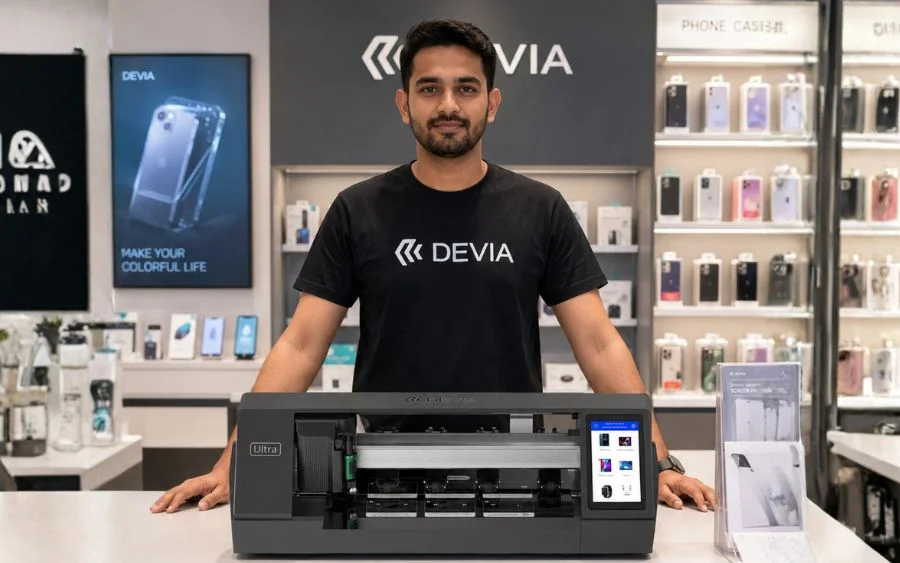
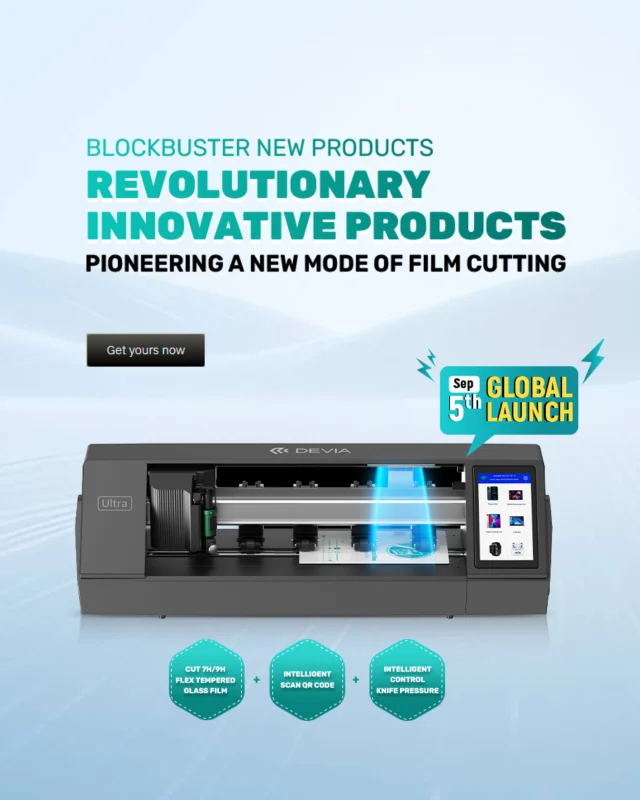
Plotter Ultra Devia: Fast & Precise
Plotter Ultra Devia is positioned as a fast and precise solution for stores that want a professional automated film cutting experience. Speed and precision both matter because a poor fit can create returns and complaints.
Customer reviews and local reputation continue to influence purchase decisions, especially for service-based retail experiences (BrightLocal, 2024). A well-installed screen protector can help build trust.
Fast cutting helps the store serve more customers. Precise cutting helps the final protector fit better.
Together, speed and precision turn the machine into a real retail asset.
What Precision Means in Practice
- Better alignment with screen edges
- Cleaner sensor and camera cutouts
- Reduced risk of lifting or poor fit
- More professional installation results
- Higher customer confidence
- Stronger repeat purchase potential
Reason 5: Why Does Automated Film Cutting Increase Business Value?
Automated film cutting increases business value because it helps stores sell screen protection as a service, not only a product. That changes how customers perceive the offer.
Accenture reported that consumers respond better to relevant recommendations and personalized shopping experiences (Accenture, 2024). A cut-on-demand screen protector is naturally personalized because it is made for the customer’s exact device.
Instead of grabbing a generic package from a shelf, the customer sees the store create the protector for their phone. That feels more valuable.
For distributors, this helps retailers justify premium pricing and repeat purchases.
Value Created for Each Channel
| Channel | Business Value | Practical Result |
| Mobile Store | More service-based sales | Higher customer conversion |
| Wholesaler | Recurring film material orders | More predictable revenue |
| Importer | Stronger product ecosystem | Better market differentiation |
| Distributor | Retailer loyalty | Longer partner relationships |
| Customer | Protector made for exact device | Better perceived value |
How To Set Up A Profitable Cell Phone Accessories Store Using Automated Film Cutting
To set up a profitable cell phone accessories store using automated film cutting, place the plotter where customers can see the service. Do not hide it in the back of the store.
Retailers continue seeking ways to increase average ticket value and create better in-store experiences (PwC, 2024). A visible film cutting station can help with both.
The station should include the cutting plotter, film samples, case displays, lens protectors and cleaning kits. This makes it easy to sell a full protection bundle.
Staff should be trained to explain the service in one simple sentence.
Practical Setup Plan
- Place the cutting plotter near the checkout counter.
- Show hydrogel, EPU, privacy and matte film options.
- Display phone cases and lens protectors nearby.
- Create a “protect your phone today” service message.
- Train staff to ask every phone customer about screen protection.
- Offer installation with every film sale.
- Track daily cuts, film type and device model.
- Reorder materials based on real sales data.
Devia Global shares additional profit ideas in 7 powerful ways screen protection boosts store profits.
How Should Distributors Sell Automated Film Cutting to Retailers?
Distributors should sell automated film cutting as a business upgrade. Store owners care about profit, inventory control and customer service.
B2B buyers increasingly expect suppliers to provide product education, operational clarity and business value before purchase (McKinsey, 2024). This means the distributor’s pitch must be clear and practical.
The strongest message is simple: “You can serve more device models with fewer pre-cut SKUs and create recurring screen protection sales.”
That speaks directly to the store owner’s daily reality.
Distributor Sales Pitch
- Reduce dead stock from old screen protector models
- Offer more device compatibility with film templates
- Turn screen protection into an in-store service
- Sell premium hydrogel and EPU film options
- Increase average ticket with cases and chargers
- Create repeat material orders with the distributor
Automated Film Cutting vs Traditional Screen Protector Distribution
Traditional screen protector distribution is usually based on volume, model availability and price. Automated film cutting adds service, customization and recurring materials to the model.
Supply chain complexity remains a key concern for importers and wholesalers managing cross-border product portfolios (KPMG, 2024). A system that reduces SKU pressure can be valuable.
Traditional distribution still works for popular models. Automated cutting becomes stronger when the retailer needs broader coverage and less inventory waste.
| Factor | Traditional Distribution | Automated Film Cutting |
| Inventory | Many model-specific SKUs | Film materials plus templates |
| Device Coverage | Limited by stock availability | Broader when templates are updated |
| Retail Experience | Product sold from package | Protector cut and installed as a service |
| Recurring Revenue | Depends on reordering pre-cut models | Driven by film material replenishment |
| Profit Positioning | Often price-driven | Can support premium service pricing |
| Customer Perception | Standard accessory purchase | Customized protection service |
What Materials Should Distributors Offer With Film Cutting Systems?
Distributors should offer multiple film types because customers have different needs. Some want basic protection. Others want privacy, premium touch, stronger resistance or matte finish.
Consumer electronics buyers compare durability, feel and quality when choosing accessories for premium devices (Consumer Technology Association, 2024). A broader film menu helps retailers match the right product to the right customer.
Hydrogel film is a strong starting point because it is flexible and widely useful. EPU film can be positioned as a premium option.
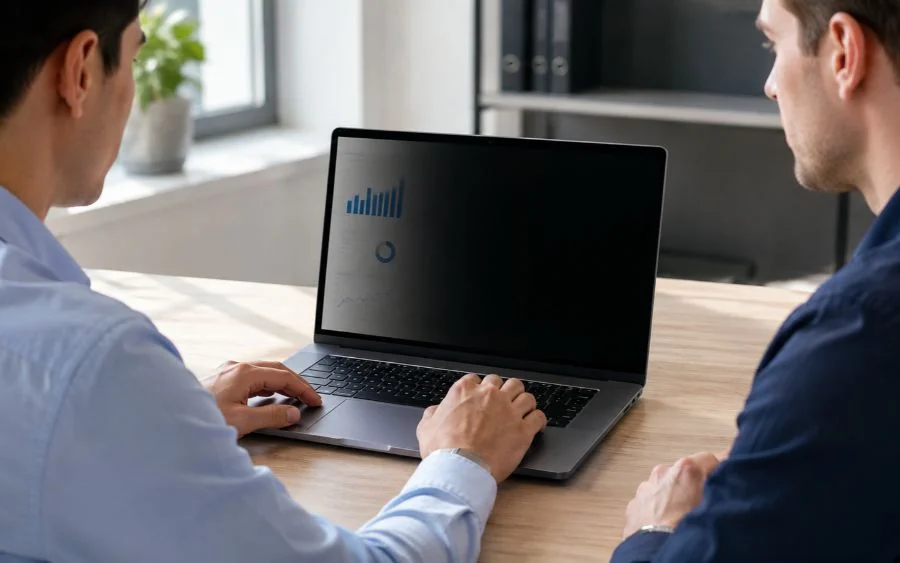
Privacy film creates an easy upsell for professionals, commuters and travelers.
Recommended Film Menu
- Standard hydrogel film
- 9H hydrogel film
- EPU premium film
- Privacy film
- Matte anti-glare film
- Back protection film
- Tablet film
- Smartwatch film
Devia Global also discusses screen protection trends in the biggest surprise in the digital world this year.
What Should Buyers Check Before Choosing an Automated Film Cutting System?
Buyers should evaluate the full system, not only the machine. The plotter, film materials, template database, installation process and supplier support all matter.
Global trade remains essential for wholesale and import businesses that depend on reliable product sourcing and replenishment (World Bank, 2024). Supplier stability should be part of the buying decision.
A cheap machine can become expensive if templates are weak or film supply is inconsistent. A strong system should support daily retail use.
Buyer Checklist
- Does the plotter support popular phone models in your market?
- Are templates updated regularly?
- Can the system cut hydrogel, EPU and privacy films?
- Is the cutting process easy for store staff?
- Does the supplier provide training or guidance?
- Can film materials be reordered reliably?
- Can the store create a profitable service around the machine?
- Does the distributor offer starter kits for retailers?
FAQ: What Do Buyers Ask About Automated Film Cutting?
Why are distributors switching to automated film cutting?
Distributors are switching to automated film cutting because it reduces pre-cut screen protector inventory, helps retailers serve more device models, creates recurring film material sales and improves the business value of screen protection. Instead of selling only finished protectors, distributors can offer a complete system with a cutting plotter, hydrogel films, EPU films, installation tools, training and replenishment.
Is automated film cutting profitable for mobile stores?
Automated film cutting can be profitable for mobile stores when it is used as a visible service and not hidden as a backroom tool. Stores can cut screen protectors on demand, install them for customers and bundle them with cases, chargers and lens protectors. Profit depends on daily installation volume, material cost, selling price, staff training and how well the store promotes the service.
How does a cutting plotter reduce inventory risk?
A cutting plotter reduces inventory risk by replacing many pre-cut screen protector SKUs with film rolls or sheets and digital templates. Retailers do not need to guess demand for every phone model. They can cut the protector when the customer arrives. This helps stores avoid dead stock from outdated models and makes it easier to serve new, older and less common devices.
What materials work with automated film cutting?
Automated film cutting can work with several screen protection materials, depending on the plotter and supplier system. Common options include hydrogel film, 9H hydrogel film, EPU film, privacy film, matte film, back protection film and film for tablets or smartwatches. The best material choice depends on customer demand, device compatibility, touch feel, protection level and retail positioning.
Who should invest in automated film cutting?
Automated film cutting is a strong fit for mobile stores, repair shops, accessory retailers, wholesalers, importers and distributors that want to grow in screen protection. It is especially useful for businesses serving many device models or selling to stores that struggle with pre-cut inventory. The model becomes stronger when combined with film replenishment, installation training and retailer sales support.
Read Also
Final Recommendation for Distributors and Mobile Stores
The Top 5 Reasons Why Distributors Are Switching to automated film cutting all point to the same conclusion: screen protection is stronger when it becomes a system. A distributor can sell machines, films, tools, training and replenishment instead of competing only on pre-cut protector price.
For mobile stores, automated film cutting can help serve more devices, reduce missed sales, improve the customer experience and create a profitable screen protection station.
To explore automated film cutting, Devia Plotter Ultra, hydrogel films, EPU films and screen protection solutions for B2B growth, visit Devia Global automated film cutting and mobile accessories solutions.